

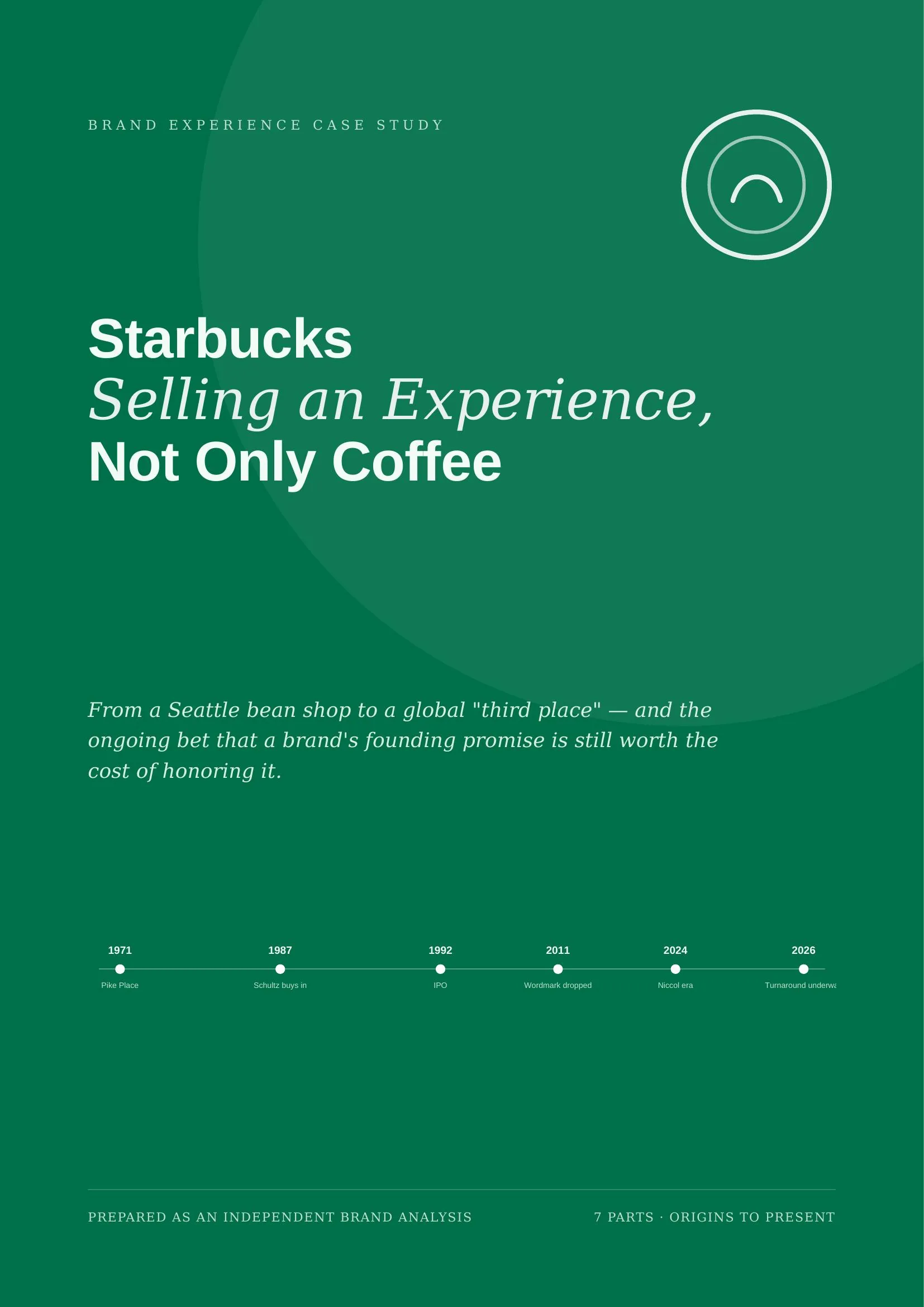
Selling an Experience, Not Only Coffee
Starbucks transformed from a small Seattle bean shop into a global “third place” — a space between home and work built around coffee, atmosphere and human connection.
From Coffee Shop to Global Lifestyle Brand
A case study in customer experience, brand consistency, store culture, digital loyalty, and global-local marketing.
Independent educational case study. Not affiliated with Starbucks Corporation. Formatted for marketing analysts and brand strategists.
Year Founded
Originated at Seattle’s historic Pike Place Market as a single retail roaster of premium coffee beans.
Global Stores
Network spanning company-operated locations and licensed storefronts globally across major metroplexes.
Markets & Countries
Deep international penetration balancing global operational standardisation with local cultural adaptation.
Active US Rewards Members
Industry-defining digital loyalty program driving over half of company-operated US tender volume.
The Starbucks Journey
How a regional whole-bean seller evolved into the world's most pervasive community beverage platform.
Pike Place Roots
Starbucks opens in Seattle's Pike Place Market. Founded by Jerry Baldwin, Zev Siegl, and Gordon Bowker, the store initially sells premium whole-bean coffee, tea, and spices without ready-to-drink espresso beverages.

The Milan Revelation
Howard Schultz travels to Milan, Italy. Mesmerized by the theatre, aroma, and social community of Italian espresso bars, he conceives translating the Italian coffee ritual into an American community gathering place.

International Expansion
Starbucks crosses the Pacific, opening its first international location in Tokyo's Ginza district. This marked the blueprint for international licensing, joint ventures, and market-specific menu localisation.

Mobile Order & Pay Ecosystem
Nationwide roll-out of Mobile Order & Pay in the US app. Starbucks becomes a fintech and digital powerhouse, streamlining store queues and capturing rich first-party behavioural data.

The Strategic Metamorphosis
A comparative breakdown illustrating how Starbucks re-architected its core business model from commodity coffee merchant to experiential cultural titan.
Commodity Bean Retailer
- Product-Oriented: Focus strictly on roasting dark beans and selling bagged commodities.
- Transactional Relationship: Ephemeral customer visits with no systematic loyalty incentives.
- Localized Footprint: Limited geographic scope confined to the Pacific Northwest.
- Functional Marketing: Basic price-and-origin messaging without lifestyle positioning.
Global Lifestyle Phenomenon
- Experience-Centric: Curated acoustics, aromas, artisanal seating, and personalized barista hospitality.
- Digital Loyalty Engine: Deep personalization, pre-loaded stored value cards, and predictive algorithmic offers.
- Ubiquitous Distribution: Traditional cafés, drive-thrus, express pickup nodes, and grocery CPG channels.
- Cultural Symbolism: Iconic green cups and seasonal cultural rituals (e.g., Red Cups, PSL).
Starbucks Doesn't Just Sell Coffee. It Sells an Experience.
Every customer touchpoint is engineered to activate subconscious emotional loyalty through multi-sensory harmony and frictionless convenience.
Aroma & Craft
Store acoustics and ventilation are calibrated so the roasting aroma dominates over cooking odors.
Personal Touch
Baristas scribbling customer names on cups converts an industrial beverage into an individual tribute.
Soundscape
Proprietary Starbucks music curation synchronized across stores globally to set an elevated tone.
Digital Flow
Mobile ordering bridges instant digital gratification with human-centric physical handoffs.
Data & Market Trajectory
Performance analytics illustrating Starbucks’ store scalability, top-line resilience, perceptual market standing, and multi-channel marketing efficiency.
Global Store Count (1995–2024)
Company-operated vs. Licensed worldwide units
Net Global Revenue ($B USD)
Annual consolidated net revenues
Brand Perceptual Positioning Map
Commodity utility vs. Emotional lifestyle affinity
Brand Equity Radar
Multi-dimensional capability index (Scale 1–10)
The Third Place: Starbucks' Biggest Strategic Idea
Sociologist Ray Oldenburg conceptualized the "Third Place" as anchors of community life. Starbucks institutionalized this at global scale—positioning its cafés between the domestic sanctuary of home and the functional productivity of work.
HOME
First Place (Domestic)STARBUCKS
The Third PlaceWORK
Second Place (Professional)1. Comfortable Space
Warm lighting, plush lounge seating, accessible power outlets, and free Wi-Fi designed to encourage linger time.
2. Social Interaction
Barista greeting rituals and transparent counter design fostering unforced neighborhood sociability.
3. Personal Autonomy
An informal sanctuary where customers can read, conduct business interviews, study, or decompress undisturbed.
4. Predictable Quality
Strict beverage preparation consistency ensures customers feel an immediate sense of familiar stability in any foreign city.
5. Sensory Sanctuary
Carefully balanced acoustic design and rich roasted coffee aroma masking harsh street traffic noise.
6. Inclusive Access
An accessible luxury where anyone can buy into an upscale atmosphere for the price of a single beverage.
Distinctive Brand Assets
How relentless consistency across sensory and visual touchpoints created unmatched global mental availability.

The White Cup & Green Apron
A walking billboard. The minimalist white cup adorned with the signature green emblem turns millions of daily commuters into brand advocates.
Handwritten Cup Names
A human micro-interaction engineered for social shareability, personal recognition, and viral organic reach across social channels.

Seasonal Packaging Rituals
The annual debut of Holiday Red Cups acts as a cultural harbinger of the winter season, generating millions in organic media value.

Bespoke Store Architecture
Locally sensitive material selections (reclaimed timber, brass fittings) paired with signature green accents creating instantly identifiable spaces.
Expanding the Beverage Ecosystem
Starbucks broke past morning caffeine dependency by continuously architecting afternoon treats, cold refreshments, and customizable lifestyle beverages.
Campaign Spotlights
Detailed breakdown of high-impact marketing initiatives that bridged product launches with cultural conversation.

Pumpkin Spice Latte (PSL)
Created an entirely new seasonal flavor category and turned autumn into a proprietary Starbucks revenue window.

The Holiday Red Cup Debut
Utilizing packaging redesign as an unmissable annual event that signals the arrival of the holiday retail season.
Mobile Order & Pay Transformation
Transforming loyalty from plastic punch-cards into an essential, high-frequency daily utility app.
Starbucks Turned Loyalty Into a Digital Ecosystem
By embedding stored-value accounts with gamified star tiers and algorithmic recommendation engines, Starbucks built an unassailable customer retention flywheel.
The Data-Loyalty Growth Loop:
- Customer Activity: Morning order placed via app.
- Data Aggregation: AI captures timing, location, custom syrups, temperature preference.
- Algorithmic Offer: Targeted afternoon double-star challenge sent via push notification.
- Margin Incremental Visit: Second transaction completed before 3 PM.
- Retention Compound: Stored balance remains in app, lowering payment processing fees.
Competitive Landscape Analysis
Comparing strategic vectors, positioning models, and unit-economic priorities against direct and indirect beverage competitors.
| Strategic Dimension | Starbucks | Dunkin' | Costa Coffee | McCafé | Independent Specialty |
|---|---|---|---|---|---|
| Core Brand Positioning | Premium "Third Place" & Lifestyle | Fast, accessible on-the-go fuel | European style coffee chain | Low-cost value addition | Artisanal third-wave connoisseurship |
| Pricing Architecture | Premium ($4.50 – $8.00+) | Value / Moderate ($2.50 – $5.00) | Moderate ($3.50 – $6.00) | Value ($1.50 – $3.50) | Super Premium ($5.50 – $12.00) |
| Store Environment | Lounge, music, lingering haven | Utilitarian grab-and-go | Comfortable high-street café | Fast-food dining room | Minimalist, craft roastery aesthetic |
| Digital & App Ecosystem | Industry benchmark (Stored Value leader) | Strong app, rewards-driven | Standard digital card | Integrated McDonald's app | Minimal / Square point-of-sale |
| Customization Depth | Near infinite (Syrups, milks, foams) | Moderate customization | Standard milk & syrup choices | Basic options | Limited (roaster purist preference) |
| Core Target Audience | Urban pros, students, lifestyle seekers | Commuters seeking fast caffeine | Broad European mass market | Budget-conscious fast-food diners | Coffee purists & craft enthusiasts |
Strategic Challenges & Balanced Brand Responses
An objective assessment of structural headwinds, operational friction, and how Starbucks mitigates risk.
Operational Complexity vs Speed
Infinite cold drink customizations (cold foams, extra shots) cause store throughput bottlenecks and barista exhaustion during peak morning rush.
Erosion of the "Third Place"
With mobile order and drive-thru representing the majority of US orders, cafés risk turning into chaotic pick-up depots rather than tranquil sanctuaries.
Value Perception & Inflation Pressure
Rising prices approaching $8 for premium cold beverages encourage budget-conscious consumers to seek lower-priced alternatives.
“Starbucks Sells a Ritual, Not Just a Beverage.”
The universal strategic principles that enabled Starbucks to turn a agricultural commodity into an enduring global lifestyle habit.
1. Product into Experience
Commodities compete on price; experiences command price elasticity and deep consumer forgiveness.
2. Cultivate Rituals
Tie consumption to emotional transition moments: morning awakening, 3 PM workday breaks, holiday celebrations.
3. Bridge Physical & Digital
Use digital utility to eliminate physical friction (queues), not to replace the warmth of human service.
4. Global Scale, Local Heart
Maintain rigorous visual assets worldwide while giving local operators autonomy to tailor food, teas, and cultural nuances.
What Modern Brands Can Learn From Starbucks
Strategic takeaways for digital marketers, creative agencies, and growth architects designing iconic consumer brands.
Brand Storytelling
Consistency builds mental shortcuts. Aligning story, packaging, interior design, and digital creative reinforces memory structures that outlast performance ad cycles.
Social UGC Engines
Design products for the feed. Starbucks turns drinks into cultural badges: vibrant ombre gradients, personalized named cups, and seasonal color transitions make customers your ad creators.
Multi-Tier Content Systems
One core seasonal moment (e.g., Autumn Harvest) should power Reels, TikTok barista trends, CRM automation, hyper-local influencer activations, and retail point-of-sale assets.
Retention-First Funnels
Acquisition without retention is a leaky bucket. First-party loyalty ecosystems turn sporadic social media followers into predictable lifetime revenue streams.
Sources & Documentation
This educational case study synthesizes public corporate filings, financial disclosures, and established business literature.
-
Starbucks Corporation Form 10-K Annual Report (FY 2023 & FY 2024)Verified Data
-
Starbucks Investor Relations Fact Sheets & Q4 DisclosuresVerified Data
-
Schultz, Howard & Yang, Dori Jones (1997). 'Pour Your Heart Into It'Academic / Memoir
-
Brand Perceptual & Equity Radar ModelsIllustrative Framework
Want a brand like this?
Let's talk about what a similarly disciplined brand transformation could look like for you.
Book a Strategy Call